
What we measure for you
The emotional signature of your fragrance, person by person
- Emotional responseWhether your fragrance draws people in, through brain markers associated with approach, not only in words.
- Focus and mental effortWhether it helps people stay engaged during a task.
- Who respondsWhich consumers react to your fragrance, and how, instead of a single average.
The key insight
Two people, two opposite shifts
Ten people did the same attention task twice: once without perfume, once after smelling their favourite perfume for six minutes. We measured frontal alpha asymmetry, a brain marker of how much something draws us in [2]. Usable data for this measure: 7 of the 10 participants.
- In 3 of 7 people, asymmetry shifted toward approach, the drive to move toward something.
- In 4 of 7, it shifted the other way, toward a more reserved response.
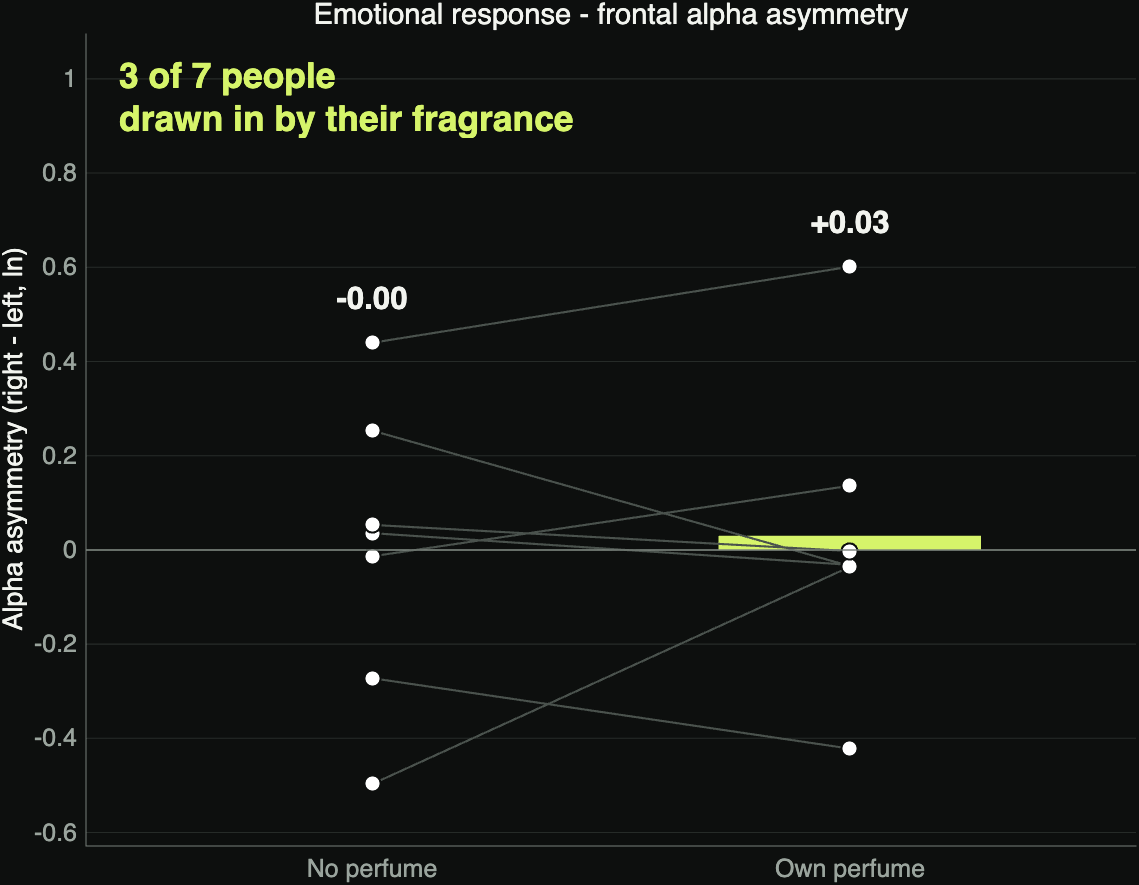
The perfume session always came second, and there was no unscented session, so these shifts cannot be attributed to the perfume itself: time, practice or the order of the sessions can move this measure too. Only a controlled study can tell.
This is the insight a standard consumer test misses. Averaged together, the two groups cancel each other out and the fragrance looks neutral. Measured person by person, the responses differ, and not in the same direction for everyone. For a brand, that difference is where targeting, messaging and formula choices begin.
Why it matters for your brand
From a single average to decisions you can act on
- Substantiate your claims before the campaign. “Relaxing”, “uplifting”, “boosts confidence”: measured evidence, checked before launch, not after.
- Find your responders. Know which consumers your fragrance works for, and build your targeting and messaging around them.
- Choose the right formula. Compare two versions, or your fragrance against a competitor’s, on what people feel, not only on what they say.
- Measure in real conditions. Wearable headbands and wristbands: the same measures can be taken in a store, at a launch event or at home.
- Combine brain, body and words. Brain measures capture what people cannot put into words. A questionnaire tells you how they describe it. Together, they give you the full picture.
What we would build for your fragrance
A study designed for your claim
The dataset we analysed was collected for another question. For a brand, we would design the study around your claim:
- Your fragrancesTwo formulas, or yours against a benchmark.
- Your consumersA panel that matches your target market.
- A clean comparisonAn unscented control, with sessions in alternating order, so the effect of the fragrance stands on its own.
- Reported emotionsA fragrance-specific emotion questionnaire, alongside the sensors.
- Intensity and wear timeHow the effect changes with concentration and over hours on the skin.
Deliverables: protocolsessionsphysiological measuresperson-level resultsclaim recommendations
A second look: focus
Focus claims need more than an average
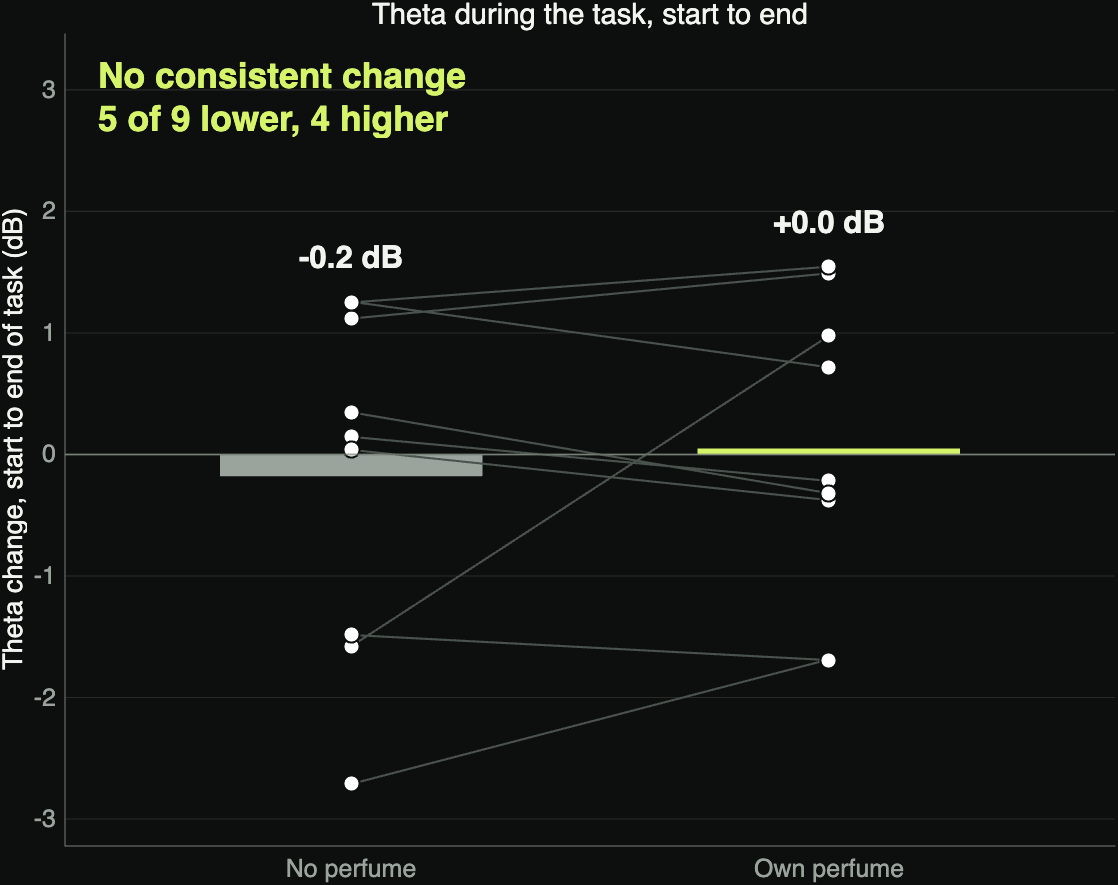
Frontal theta, a marker of mental effort and drowsiness [3], was higher with perfume in 7 of 9 participants. The perfume session always came second, so session order may play a role: only a controlled study can tell. During the task itself, theta stayed stable, with or without perfume.
Our method
The same task, the same person, with and without fragrance
The dataset follows 10 participants through sessions of the same working-memory task (n-back), about 15 minutes each [1]. Brain activity was recorded with a wearable EEG headband.
- Clean2-second segments with eye blinks or movement removed; 85 to 99% of the signal kept in each session.
- AnalyseEach participant compared with their own session without perfume.
- ReportEvery participant shown, not just the average.
| Measure | Tool | What it shows |
|---|---|---|
| Frontal alpha asymmetry | EEG, front of the head | How much something draws us in: approach motivation [2] |
| Frontal theta | EEG, front of the head | Mental effort and drowsiness [3] |
Limits: 10 participants, self-chosen perfumes, fixed session order, no unscented control. Two participants were excluded from the asymmetry measure because one electrode lost contact, and one participant’s perfume session was excluded from all measures because of a signal artefact at its start. These results are exploratory.